The respondent is a Moroccan national living in Bologna who was stopped by French police while travelling by train across the Italian-French border.

At the time of the incident, he was in possession of an official receipt confirming that he had applied for the renewal of his residence permit (permesso di soggiorno) in Italy. He was travelling together with four other individuals: two Tunisian nationals, one Algerian national, and another Moroccan national. He was intercepted during a border control operation in the evening and subsequently taken into custody by the French authorities.
Menton Train Station. Location where the group was stopped
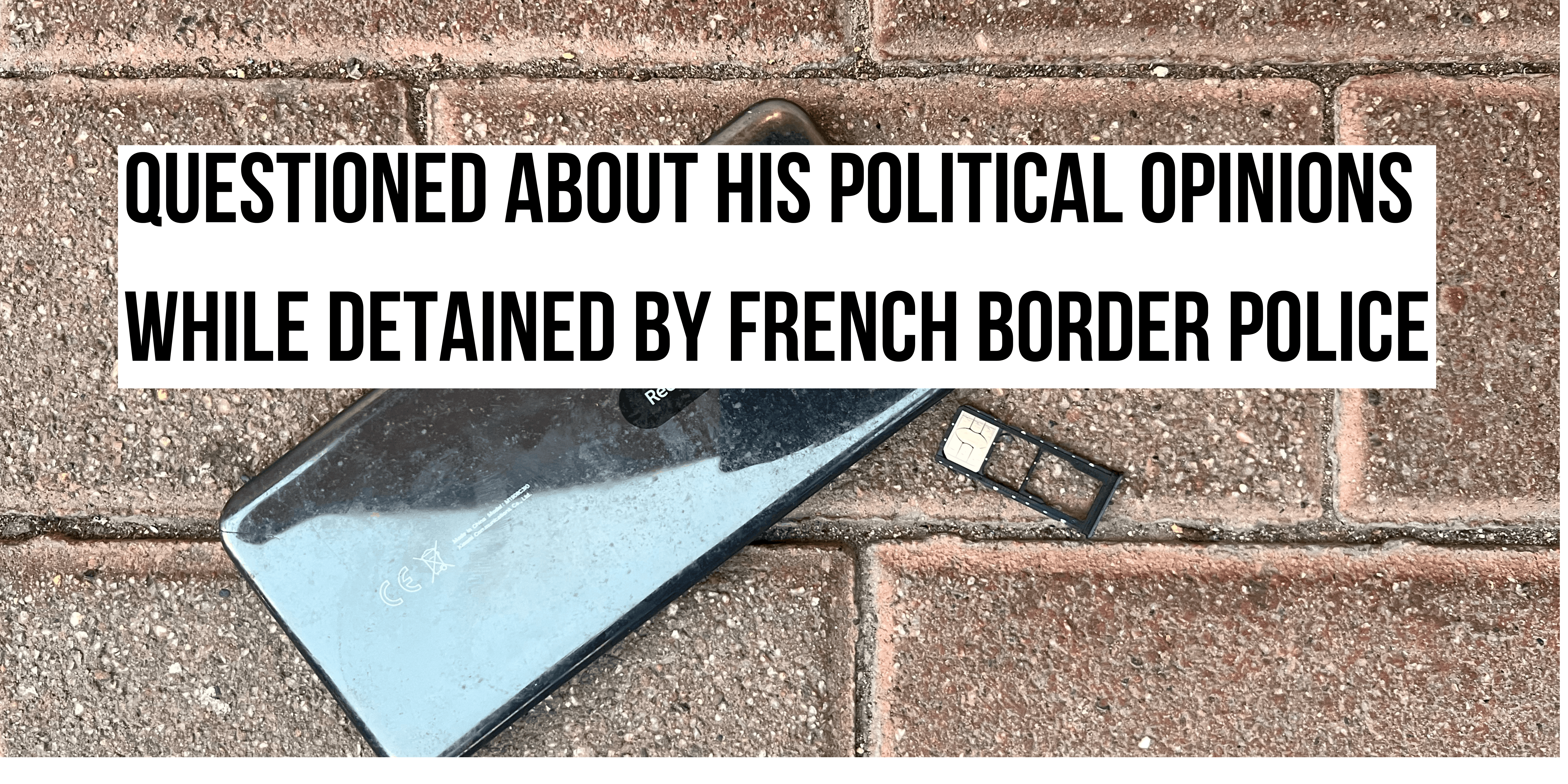
The respondent reports that he encountered the French authorities at approximately 8:00 PM while on board a train crossing the border. He was approached by uniformed French police officers conducting border checks and was subsequently removed from the train and transported by police vehicle to border police facilities. The respondent stated that his phone was confiscated, his SIM card was removed, and its contents were examined.

He was questioned for approximately 40 minutes without the assistance of an interpreter and was not informed of his rights.

During the interview, he was asked about his political opinions, including specific questions regarding his position on the actual situation in Palestine in French, which he perceived as unrelated to his case and inappropriate in that context. He was later interviewed also by the Italian Police, which the border monitor team didn’t reported active for a while.
Centre de coopération de police et de dogana. Location where the detention and pushback took place.
He reports being held in what he described as a plastic container used as a holding space. He stated that he was required to sleep on a mattress placed on the floor, without blankets, and that the facility was dirty and inadequately maintained. During his detention, his fingerprints were taken, but he was not provided with any written record (procès-verbal) documenting the procedure.

We met him the next morning, he was released at 9.00 a.m and had to wait 3 hours at the bus stop. The police didn’t give him a ticket or any information on what to do or where to go.

legal analysis

During his detention at the border police facility, the respondent reports that his fingerprints were taken without being provided with any written record (procès-verbal). He further stated that his SIM card was checked and that he was questioned about his political ideas and positions, including his views on the genocide in Palestine. These actions go against Article 8 of the European Convention on Human Rights (ECHR), Articles 7 and 8 of the EU Charter of Fundamental Rights, and the General Data Protection Regulation (GDPR), as the collection and processing of biometric and personal data, considered particularly sensitive data such as political opinions must be lawful, necessary, proportionate, and transparent.Additionally, the respondent reports that he was interviewed for 40 minutes without an interpreter, was not informed of his rights, and did not receive any documentation related to the fingerprinting procedure or explaining the legal basis for his detention, which appears to be contrary to Arts. 6 and 13 ECHR and Arts. 47 and 18 of the EU Charter, as the absence of interpretation, lack of information on rights, and failure to provide written documentation undermine due process guarantees and may prevent effective access to remedies and, where applicable, access to asylum procedures.