LIVE Bloody borders testimonies(34)
The respondent remembers his life in Afghanistan as “tranquillo” – peaceful. He worked with his father in their family business, supplying chicken to fifteen cities across the country, including to the police. He also went to school from time to time.

When asked why he decided to leave, the respondent says, “It was my dream, but then the Taliban came, and it caused too much mushcila,” meaning worry in Pashto. He was sixteen when he and his father fled Afghanistan, two weeks after the Taliban took power in November 2021.

They traveled together to Turkey. The respondent managed to cross into Bulgaria, but his father was pushed back several times and remained in Istanbul. He hopes that once he receives refugee protection in Italy, his father, mother, and four younger siblings – “bambini,” as he calls them – can join him through family reunification.

The respondent dreams of opening his own restaurant in Italy. He has already worked in several restaurants in Belgium and is a skilled cook. “I don’t want to work inside the kitchen, basta,” he says. “I’ve already worked a lot.”

In Afghanistan, the Taliban pressured his father to shut down the family business and repeatedly sent threatening letters. To reach safety, the respondent crossed eleven countries over six months before arriving in Belgium, where his asylum claim was rejected three times. The authorities said that only his father was in danger because, as a minor, he had not worked officially in the business.
“Their hearts stopped from exhaustion. […] If you are on the move, no doctors would help you – only friends. I left the place; I couldn’t do anything. I was just sad and cried”.
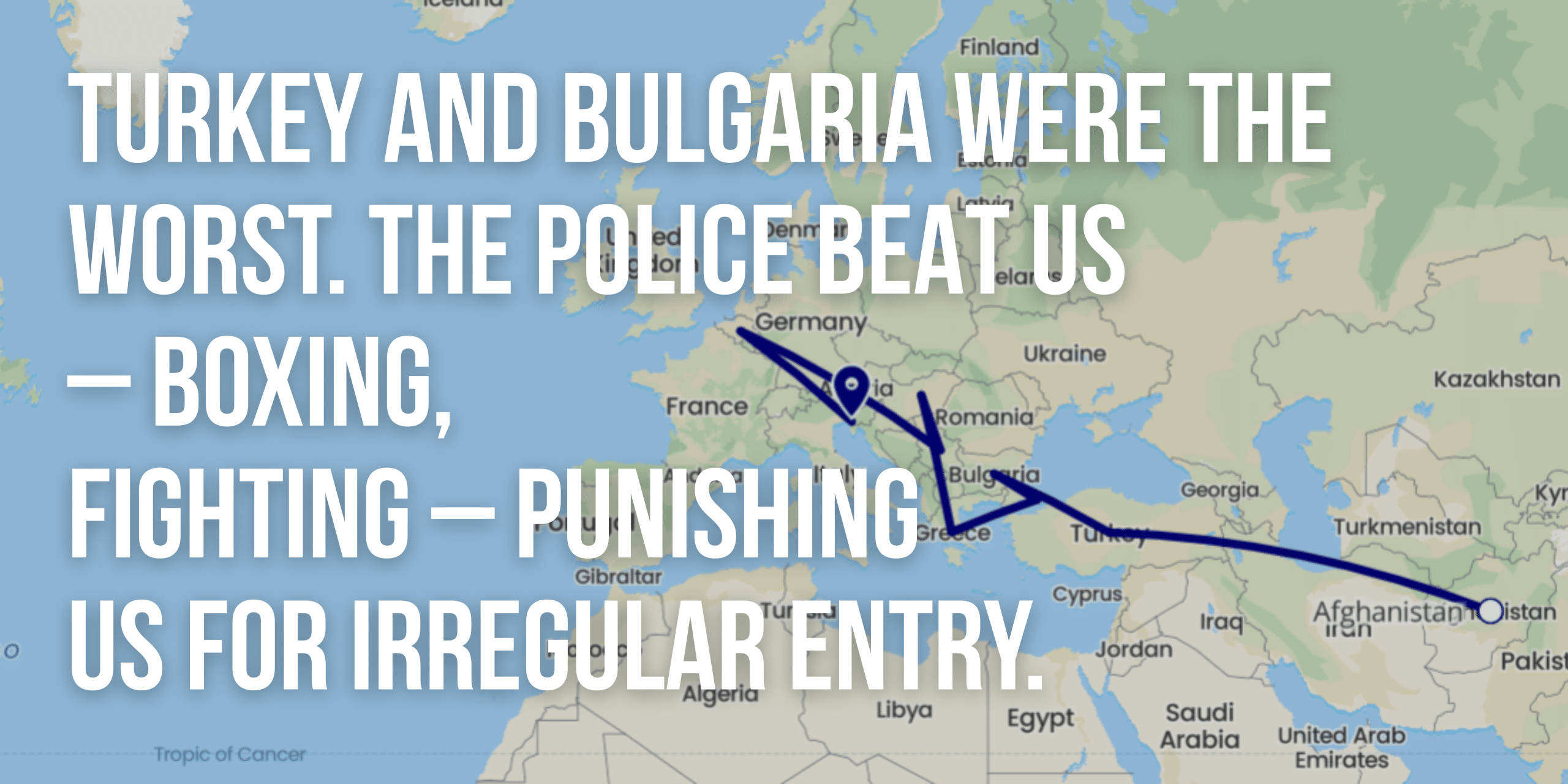
The respondent’s journey along the Balkan route was marked by violence, detention, and pushbacks. He was arrested twice in Turkey and once in Bulgaria and Greece, each time spending around a month in detention. “Turkey and Bulgaria were the worst,” he recalls. “The police beat us – boxing, fighting – punishing us for irregular entry.” Hungary pushed him back to Serbia eight times.

On the Turkish-Bulgarian border, the respondent saw people who had died just a few hours earlier. “Their hearts stopped from exhaustion,” he says. “If you are on the move, no doctors would help you – only friends. I left the place; I couldn’t do anything. I was just sad and cried”.

Some memories fade, but others are impossible to erase. In Bulgaria, the respondent was beaten so badly that he avoided video calls with his family for two weeks so they would not see his injuries. He received no medical help. “If I went to the hospital,” he says, “they would have deported me to Turkey again.”

The respondent believes that for people on the move, violence is a constant threat. “It doesn’t matter where the Bulgarian police find you or how old you are,” he says. “They use violence anyway.”
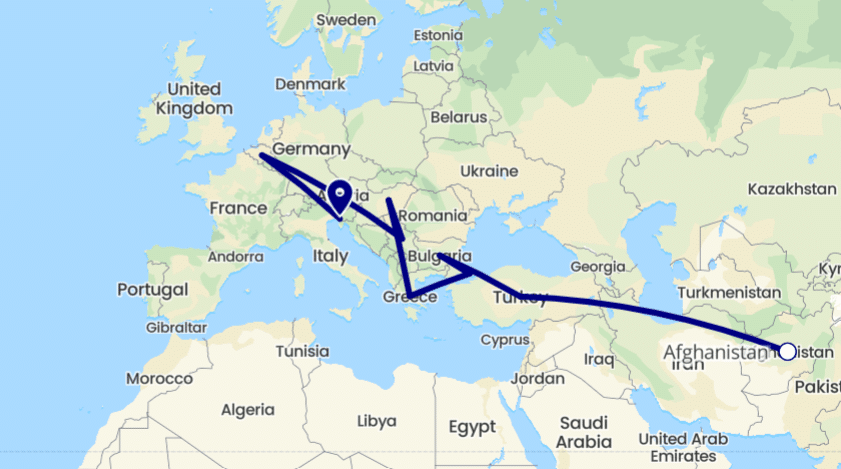
Map 2
The respondent’s route from Afghanistan, to Trieste, Italy
The respondent thinks that while on the move you meet different kinds of people. Near the Iranian border in Turkey, a Kurdish woman took him and three friends, all minors, into her home. She let them rest for two days, gave them food, clothes, and shoes. “She was a kind mother of three,” He recalls. “When I left, I told her, manana, mama (thank you, mother).”

In Italy, the respondent first lived in an abandoned building. Later, a friend introduced him to an Italian man, an Italian teacher who had already hosted Afghan refugees. The respondent stayed one night at his home, and the next day the man handed him the keys, saying, “From now, it is your home too.” Every morning, the respondent attends Italian classes with this man. At home, he cooks for everyone – from traditional Afghan dishes to pasta and pizza.